
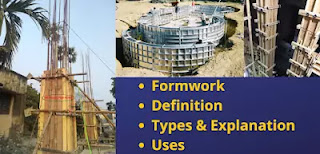
Definition of formwork
Requirement properties for Formwork
 |
| Form work |
Formwork is a mould or open box, like container into which fresh
concrete is poured and compacted. When concrete is set, the formwork is removed
and solid mass is produced in the shape of the inner face of the framework. The
top of the formwork is normally left open.
Requirement properties for Formwork
1. Strong and enough to resist the pressure the pressure for
or the weight of concrete.
or the weight of concrete.
2. Rigid enough to retain the shape without undue deformation.
3. Economical in terms of the total cost of the forms
4. Sufficiently watertight to avoid leakage of joints
Types of Formwork
Depending of the materials
A. Timber Formwork
B. Metal Formwork
C. Plastic Formwork
 |
| Form work for column |
A.
Timber
formwork
Timber
formwork
There are two types of timber formwork, they are
(i) Lumber Formwork
It is commonly available material and has excellent strength
and cost factor.
and cost factor.
(ii) Plywood Formwork
The use of plywood in concrete forming has improved quantity if
finished concrete.
finished concrete.
B.
Metal formwork
Metal formwork
 |
| Metal Formwork |
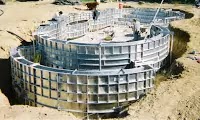
The initial cost of metal formwork is more than timber
formwork but the number of reuse of metal formwork is higher than that of
timber. In long run metal form work is more economical. Steel or aluminum or
magnesium is the most widely used metals.
C.
Plastic
formwork
Plastic
formwork
They have impervious surface that usually create a smooth
finish to the concrete. Plastic formwork could be reinforced or un- reinforced.
Plastic Formwork is lighter but less durable than metal formworks.
finish to the concrete. Plastic formwork could be reinforced or un- reinforced.
Plastic Formwork is lighter but less durable than metal formworks.
Depending
Upon Shape
Upon Shape
a.
Column Formwork
Column Formwork
b.
Beam Formwork
Beam Formwork
c.
Slab Formwork
Slab Formwork
d.
Wall
Formwork
Wall
Formwork
a.
Column Formwork
Column Formwork
Column formwork is made usually either of timber or metals panels.
The box is held in positions by steel columns clamps or bolted yokes and
support by the timber props.
The box is held in positions by steel columns clamps or bolted yokes and
support by the timber props.
b.
Beam
formwork
Beam
formwork
 |
| Formwork for beam |
Beam formwork consist of open through the section and
because it is not closed at the top requires more supporting formwork to
restrain the sides. The supports need to be maintained to the soffit and also
provide lateral support to the sides. Generally metal and timber formwork is
used.
because it is not closed at the top requires more supporting formwork to
restrain the sides. The supports need to be maintained to the soffit and also
provide lateral support to the sides. Generally metal and timber formwork is
used.
c.
Slab Formwork
Slab Formwork
Floors are required a larger area of formwork to be provided
usually from beam to beam. Timber and metals props can be used for vertical
support.
usually from beam to beam. Timber and metals props can be used for vertical
support.
d.
Wall Formworks
Wall Formworks
Wall formworks is a simpler than other concrete unit as the
actual forces against it are less. The panels at the both sides are held in
position by ties. Ties are also used as spacer. Wall support system are usually
sloping props at satisfactory intervals.
actual forces against it are less. The panels at the both sides are held in
position by ties. Ties are also used as spacer. Wall support system are usually
sloping props at satisfactory intervals.
Forming
Ties
Ties
When the concrete is placed in wall formwork, the pressure
exerted by the fresh concrete tends to force the opposite sides of the formwork
apart. Economical solutions of this problems to use of soldiers on either side
of the formwork. Because soldiers are prevent form moving apart by use of steel
rods passing through the concrete to connect the two soldiers together.
exerted by the fresh concrete tends to force the opposite sides of the formwork
apart. Economical solutions of this problems to use of soldiers on either side
of the formwork. Because soldiers are prevent form moving apart by use of steel
rods passing through the concrete to connect the two soldiers together.