
HOW TO STORE CEMENT ON SITE?
STORING OF
CEMENT ON SITE – GUIDELINES
CEMENT ON SITE – GUIDELINES
·
Cement
should be store in a building which is dry, leak proof and moisture proof as far
as possible.
Cement
should be store in a building which is dry, leak proof and moisture proof as far
as possible.
·
The
number of windows should be minimum in the storage cement building.
The
number of windows should be minimum in the storage cement building.
·
If
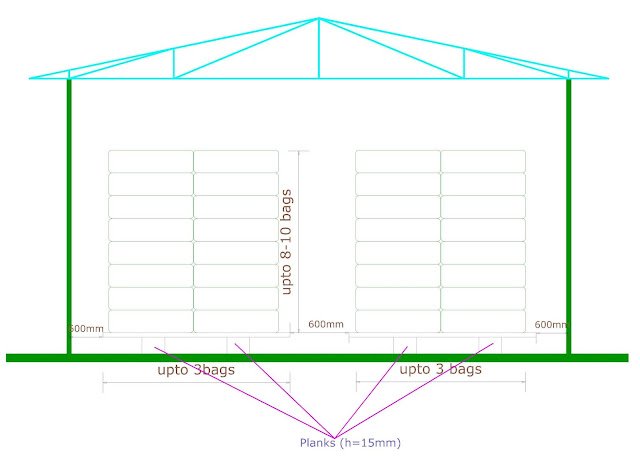
the floor is damp than stack the cement bags off the floor on wooden planks in
such a way, so that it is about 150 mm – 200 mm above the damp floor.
If
the floor is damp than stack the cement bags off the floor on wooden planks in
such a way, so that it is about 150 mm – 200 mm above the damp floor.
·
During
storing cement we have to maintain a space of 300 mm all around between the
exterior walls and the stacks.
During
storing cement we have to maintain a space of 300 mm all around between the
exterior walls and the stacks.
·
Cement
bags should be stack close to each other to reduce circulation of air between
bags.
Cement
bags should be stack close to each other to reduce circulation of air between
bags.
·
The
height of cement bags stack should not be more than 10 bags to prevent the
possibility of lumping under pressure.
The
height of cement bags stack should not be more than 10 bags to prevent the
possibility of lumping under pressure.
·
The
width of the cement bags stack should not be more than four bags length or 3
meters.
The
width of the cement bags stack should not be more than four bags length or 3
meters.
·
While
stacking cement bags more than 8 bags high, the cement bags should be arranged
alternately length-wise and cross-wise, so as to tie the stacks together and
minimize the danger of toppling over.
While
stacking cement bags more than 8 bags high, the cement bags should be arranged
alternately length-wise and cross-wise, so as to tie the stacks together and
minimize the danger of toppling over.
·
Stack
the cement bags in such a manner so as to facilitate their removal and use in
the order in which they are received.
Stack
the cement bags in such a manner so as to facilitate their removal and use in
the order in which they are received.
·
Put
label showing date of receipt of cement on each stack of cement bags to know
the age of cement.
Put
label showing date of receipt of cement on each stack of cement bags to know
the age of cement.
·
When
it is required to store cement bas for a long period of time or for during the
monsoon seasons, completely enclose the stack by a water proofing membrane such
as polyethylene.
When
it is required to store cement bas for a long period of time or for during the
monsoon seasons, completely enclose the stack by a water proofing membrane such
as polyethylene.
·
Different
types of cement bags like (OPC, PPC, PHC etc.) must be stacked and stored
separately.
Different
types of cement bags like (OPC, PPC, PHC etc.) must be stacked and stored
separately.
 |
| Storage of Cement |
HOW TO STORE
STEEL ON SITE?
Steels should be stored in such a way, so as
to avoid distortion and to prevent deterioration and corrosion. In order to prevent any compromise in the TMT steel
bars for construction, reinforced bars must be handled and stored with
precaution. Proper handling of the TMT bars is essential for its efficiency.
Handling the TMT Re-bars at construction sites involve different operations
namely – Unloading, Hoisting, Stacking, Cutting, Bending, Fabrication, Welding
etc. Since TMT steel rebar plays a crucial role in maintaining the structural
integrity and durability of the building, it is essential all these operations are
properly maintained at the construction site. Steels of different
classes should be stored separately. Follow the guidelines given below while
storing steel on site.
to avoid distortion and to prevent deterioration and corrosion. In order to prevent any compromise in the TMT steel
bars for construction, reinforced bars must be handled and stored with
precaution. Proper handling of the TMT bars is essential for its efficiency.
Handling the TMT Re-bars at construction sites involve different operations
namely – Unloading, Hoisting, Stacking, Cutting, Bending, Fabrication, Welding
etc. Since TMT steel rebar plays a crucial role in maintaining the structural
integrity and durability of the building, it is essential all these operations are
properly maintained at the construction site. Steels of different
classes should be stored separately. Follow the guidelines given below while
storing steel on site.
STORING OF STEEL REINFORCEMENT
·
Whenever the rebars are
ordered, the area where it must be unloaded must be moisture and dust free.
Also at the time of unloading, use timber beds in order to avoid contact with
dirt and water.
Whenever the rebars are
ordered, the area where it must be unloaded must be moisture and dust free.
Also at the time of unloading, use timber beds in order to avoid contact with
dirt and water.
·
Covering the steel
rebars with polythene sheets will protect the reinforced bars from moisture.
Alternatively, a covered shed can be used.
Covering the steel
rebars with polythene sheets will protect the reinforced bars from moisture.
Alternatively, a covered shed can be used.
·
Store
bars of different classes, sizes and lengths separately to facilitate issues in
such sizes and lengths so as to minimize wastage in cutting from standard
lengths.
Store
bars of different classes, sizes and lengths separately to facilitate issues in
such sizes and lengths so as to minimize wastage in cutting from standard
lengths.
·
Optimize the stacking
height for the reinforced bars. The more the stacking height, the more load
bars will have to endure at the lower layers. The excessive load may damage the
Ribs on the surface of the rebar, which in turn reduces tensile strength.
Optimize the stacking
height for the reinforced bars. The more the stacking height, the more load
bars will have to endure at the lower layers. The excessive load may damage the
Ribs on the surface of the rebar, which in turn reduces tensile strength.
·
Paint
the ends of bars of each class in distinct separate colors.
Paint
the ends of bars of each class in distinct separate colors.
·
Coat
steel reinforcement with cement wash before stacking to prevent scaling and
rusting.
Coat
steel reinforcement with cement wash before stacking to prevent scaling and
rusting.
·
If
reinforcement bars have to be stored for a long period, then stack it above
ground level by at least 150 mm.
If
reinforcement bars have to be stored for a long period, then stack it above
ground level by at least 150 mm.
STORING OF
STRUCTURAL STEEL ( I beam, C channel, Angle etc.)
·
Assign separate areas for storing
structural steel of different classes, sizes and lengths.
Assign separate areas for storing
structural steel of different classes, sizes and lengths.
·
Store it above ground level by at least
150 mm upon platforms, skids or any other suitable supports to avoid distortion
of sections.
Store it above ground level by at least
150 mm upon platforms, skids or any other suitable supports to avoid distortion
of sections.
·
In coastal areas or in case of long
storage, apply protective coating of primer to prevent scaling and rusting.
In coastal areas or in case of long
storage, apply protective coating of primer to prevent scaling and rusting.
HOW TO STORE AGGREGATES ON
SITE?
SITE?
STORING OF AGGREGATE ON SITE
·
Whenever the aggregate
and sand are ordered, the area where it must be unloaded must be moisture, mud
and dust free. Also at the time of unloading, use polythene layer on ground in
order to avoid contact with dirt and water.
Whenever the aggregate
and sand are ordered, the area where it must be unloaded must be moisture, mud
and dust free. Also at the time of unloading, use polythene layer on ground in
order to avoid contact with dirt and water.
·
Store
aggregate at site on a hard dry and level patch of ground
Store
aggregate at site on a hard dry and level patch of ground
·
While
unloading aggregate and sand if such a surface is not available then prepare a
platform of planks or old corrugated iron sheets, or a floor of bricks, or a
thin layer of lean concrete so as to prevent aggregate from contamination with
clay, dust, vegetable and other organic matter.
While
unloading aggregate and sand if such a surface is not available then prepare a
platform of planks or old corrugated iron sheets, or a floor of bricks, or a
thin layer of lean concrete so as to prevent aggregate from contamination with
clay, dust, vegetable and other organic matter.
·
While
unload aggregate and sand we have to maintain sufficient distance between
stacks of fine and coarse aggregates to prevent the material from getting
intermixed.
While
unload aggregate and sand we have to maintain sufficient distance between
stacks of fine and coarse aggregates to prevent the material from getting
intermixed.
·
At
a construction site or unloading area, if possible then construct temporary partition
walls to give each type of aggregate its own compartment.
At
a construction site or unloading area, if possible then construct temporary partition
walls to give each type of aggregate its own compartment.
·
Stack
the fine aggregate in such a place where loss due to effect of wind is minimum.
Stack
the fine aggregate in such a place where loss due to effect of wind is minimum.
·
Stacking
of the aggregates should be carried out in regular stacks. The suggested sizes
for stacks are as follows.
Stacking
of the aggregates should be carried out in regular stacks. The suggested sizes
for stacks are as follows.
|
Material
|
Size
of Stack (in m.) To find out quantity |
||
|
Length
|
Breadth
|
Height
|
|
|
Soling
stone |
5
|
2
|
0.5
|
|
5
|
1
|
0.5
|
|
|
Coarse
aggregate |
2
|
2
|
0.5
|
|
5
|
5
|
1
|
|
|
5
|
1
|
0.5
|
|
|
Fine
aggregate |
2
|
2
|
0.5
|
|
5
|
5
|
1
|
|
|
5
|
1
|
0.5
|
|