
Lab Tests on Bitumen for Pavement Construction
For
pavement construction we can check various laboratory tests on bitumen is done
to check the quality and different properties of bitumen, It is black or brown
color, it is mixture of hydrocarbons obtained by partial distillation of crude
petroleum.
pavement construction we can check various laboratory tests on bitumen is done
to check the quality and different properties of bitumen, It is black or brown
color, it is mixture of hydrocarbons obtained by partial distillation of crude
petroleum.
It contain
87% carbon, 11% hydrogen and 2% oxygen by its weight. It is obtained in solid
or semi-solid state. It is generally used as surface course for roads pavement,
roof coverings, water proofing etc. Bitumen is insoluble in water.
87% carbon, 11% hydrogen and 2% oxygen by its weight. It is obtained in solid
or semi-solid state. It is generally used as surface course for roads pavement,
roof coverings, water proofing etc. Bitumen is insoluble in water.
Tests on bitumen
There are a number of tests to assess the properties
of bituminous materials. Check Quality and
Properties for Pavement. To ensure the quality of bitumen several
tests are performed which are as follows. The following
tests are usually conducted to evaluate
different properties of bituminous materials.
of bituminous materials. Check Quality and
Properties for Pavement. To ensure the quality of bitumen several
tests are performed which are as follows. The following
tests are usually conducted to evaluate
different properties of bituminous materials.
1.
Penetration
test
Penetration
test
2.
Ductility
test
Ductility
test
3.
Softening
point test
Softening
point test
4.
Specific
gravity test
Specific
gravity test
5.
Viscosity
test
Viscosity
test
6.
Flash
and Fire point test
Flash
and Fire point test
7.
Float
test
Float
test
8.
Water
content test
Water
content test
9.
Loss
on heating test
Loss
on heating test
1. Penetration Test on
Bitumen
Bitumen
It measures the hardness or softness
of bitumen by measuring the depth in tenths of a millimeter to which a standard
loaded needle will penetrate vertically in 5 seconds
of bitumen by measuring the depth in tenths of a millimeter to which a standard
loaded needle will penetrate vertically in 5 seconds
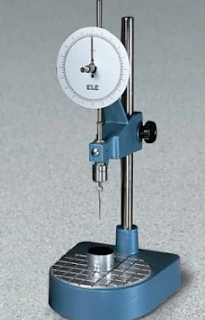
The penetrometer consists of a
needle assembly with a total weight of 100g and a device for releasing and
locking in any position. The bitumen is softened to a pouring consistency,
stirred thoroughly and poured into containers at a depth at least 15 mm in excess
of the expected penetration. The test should be conducted at a specified
temperature of 250 C. It may be noted that
penetration value is largely influenced by any inaccuracy with regards to
pouring temperature, size of the needle, weight placed on the needle and the
test temperature. A grade of 40/50 bitumen means the penetration value is in
the range 40 to 50 at standard test conditions. In hot climates, a lower
penetration grade is preferred.
needle assembly with a total weight of 100g and a device for releasing and
locking in any position. The bitumen is softened to a pouring consistency,
stirred thoroughly and poured into containers at a depth at least 15 mm in excess
of the expected penetration. The test should be conducted at a specified
temperature of 250 C. It may be noted that
penetration value is largely influenced by any inaccuracy with regards to
pouring temperature, size of the needle, weight placed on the needle and the
test temperature. A grade of 40/50 bitumen means the penetration value is in
the range 40 to 50 at standard test conditions. In hot climates, a lower
penetration grade is preferred.
By this test we can determine the hardness or softness value
of bitumen.
of bitumen.
 |
| Penetrometer |
 |
| Softening Test |
2. Ductility Test on Bitumen
The property of bitumen which allows it to undergo
deformation or elongation is called ductility of bitumen. The ductility of
bitumen is measured by the distance in Cm (centimeter), to which the bitumen
sample will elongate before breaking when it is pulled by standard specimen at
specified speed and temperature. Dimension of the briquette thus formed
is exactly 1 cm square.
deformation or elongation is called ductility of bitumen. The ductility of
bitumen is measured by the distance in Cm (centimeter), to which the bitumen
sample will elongate before breaking when it is pulled by standard specimen at
specified speed and temperature. Dimension of the briquette thus formed
is exactly 1 cm square.
The bitumen sample is heated to 75-100 degree and poured in
the mould assembly placed on a plate. These samples with moulds are cooled in
the room temperature for 30-40 min and then in water bath at 270 C
temperature. The excess bitumen is cut and the surface is leveled using a hot
knife. Then the mould with assembly containing sample is kept in water bath of
the ductility machine for about 30 minutes.
the mould assembly placed on a plate. These samples with moulds are cooled in
the room temperature for 30-40 min and then in water bath at 270 C
temperature. The excess bitumen is cut and the surface is leveled using a hot
knife. Then the mould with assembly containing sample is kept in water bath of
the ductility machine for about 30 minutes.
The machine pulls the two clips of the mold horizontally and
then bitumen elongates. The distance up to the point of breaking from the
starting point is noted as ductility value of bitumen. The minimum value should
be 75cm.
then bitumen elongates. The distance up to the point of breaking from the
starting point is noted as ductility value of bitumen. The minimum value should
be 75cm.
 |
| Ductility test |
3.
Softening Point Test on Bitumen
Softening point of bitumen indicates the point at which
bitumen attains a particular degree of softening under specified conditions of
the test.
bitumen attains a particular degree of softening under specified conditions of
the test.
The test is conducted by using Ring and Ball apparatus. A
brass ring containing test sample of bitumen is suspended in liquid like water
or glycerin at a given temperature. A steel ball is placed upon the bitumen
sample and the liquid medium is heated at a rate of 50 C per minute.
Temperature is noted when the softened bitumen touches the metal plate which is
at a specified distance below. Generally, higher softening point indicates
lower temperature susceptibility and is preferred in hot climates.
brass ring containing test sample of bitumen is suspended in liquid like water
or glycerin at a given temperature. A steel ball is placed upon the bitumen
sample and the liquid medium is heated at a rate of 50 C per minute.
Temperature is noted when the softened bitumen touches the metal plate which is
at a specified distance below. Generally, higher softening point indicates
lower temperature susceptibility and is preferred in hot climates.
 |
| Softening test |
 |
| Softening test |
4.
Specific Gravity Test on Bitumen
In paving jobs, to classify a binder, density property is of
great use. In most cases bitumen is weighed, but when used with aggregates, the
bitumen is converted to volume using density values. The density of bitumen is
greatly influenced by its chemical composition. Increase in aromatic type
mineral impurities cause an increase in specific gravity.
great use. In most cases bitumen is weighed, but when used with aggregates, the
bitumen is converted to volume using density values. The density of bitumen is
greatly influenced by its chemical composition. Increase in aromatic type
mineral impurities cause an increase in specific gravity.
In this method, take
clean and dry specific gravity bottle and take its weight(w1).in the 2nd case, fill the bottle
with distilled water and dip it in water bath for 30 minutes and note down the
weight(w2). Next, fill half the bottle with bitumen sample and weigh (w3). Finally
fill the bottle with half water and half portion with bitumen and weigh (w4).
Now we can find out specific gravity from the formulae. The specific gravity of
bitumen varies from 0.97 to 1.02.
clean and dry specific gravity bottle and take its weight(w1).in the 2nd case, fill the bottle
with distilled water and dip it in water bath for 30 minutes and note down the
weight(w2). Next, fill half the bottle with bitumen sample and weigh (w3). Finally
fill the bottle with half water and half portion with bitumen and weigh (w4).
Now we can find out specific gravity from the formulae. The specific gravity of
bitumen varies from 0.97 to 1.02.
Specific gravity = (W3-W1)/((W2-W1)-(W4-W3))
 |
| Specific Gravity of Bitumen |
5. Viscosity Test on Bitumen
Viscosity denotes the fluid property of bituminous material
and it is a measure of resistance to flow. Viscosity is the property of bitumen
which influences the ability of bitumen to spread, penetrate into the voids and
also coat the aggregates. That is it influences the fluid property of bitumen.
If viscosity of bitumen is higher, comp active effort of bitumen reduces and
heterogeneous mixture arises. And at low viscosity instead of providing
a uniform film over aggregates, it will lubricate the aggregate particles.
Orifice type viscometers are used to indirectly find the viscosity of bitumen.
The viscosity expressed in seconds is the time taken by the 50 ml bitumen
material to pass through the orifice of a cup, under standard test conditions
and specified temperature. Viscosity of a cutback can be measured with either
4.0 mm orifice at 250 C or 10 mm orifice at 250 or 400 C.
and it is a measure of resistance to flow. Viscosity is the property of bitumen
which influences the ability of bitumen to spread, penetrate into the voids and
also coat the aggregates. That is it influences the fluid property of bitumen.
If viscosity of bitumen is higher, comp active effort of bitumen reduces and
heterogeneous mixture arises. And at low viscosity instead of providing
a uniform film over aggregates, it will lubricate the aggregate particles.
Orifice type viscometers are used to indirectly find the viscosity of bitumen.
The viscosity expressed in seconds is the time taken by the 50 ml bitumen
material to pass through the orifice of a cup, under standard test conditions
and specified temperature. Viscosity of a cutback can be measured with either
4.0 mm orifice at 250 C or 10 mm orifice at 250 or 400 C.
 |
| Viscosity Test of Bitumen |
6. Flash and Fire Point Test on Bitumen
At high temperatures depending upon the grades of bitumen
materials leave out volatile. And these volatile catches fire which is very
hazardous and therefore it is essential to qualify this temperature for each
bitumen grade. Fire point of bitumen is defined as the point of lowest
temperature at which the bitumen ignites and burns at least for 5 second under
specific conditions of test. Flash and fire point test helps to control
fire accidents in bitumen coated areas. By this test we can decide the bitumen
grade with respect to temperature for particular areas of high temperatures.
materials leave out volatile. And these volatile catches fire which is very
hazardous and therefore it is essential to qualify this temperature for each
bitumen grade. Fire point of bitumen is defined as the point of lowest
temperature at which the bitumen ignites and burns at least for 5 second under
specific conditions of test. Flash and fire point test helps to control
fire accidents in bitumen coated areas. By this test we can decide the bitumen
grade with respect to temperature for particular areas of high temperatures.
7. Float Test on Bitumen
Normally the consistency of bituminous material can be
measured either by penetration test or viscosity test. But for certain range of
consistencies, these tests are not applicable and Float test is used. The
apparatus consists of an aluminum float and a brass collar filled with bitumen
to be tested. The specimen in the mould is cooled to a temperature of 50
C and screwed in to float. The total test assembly is floated in the water bath
at 500 C and the time required for water to pass its way through the
specimen plug is noted in seconds and is expressed as the float value.
measured either by penetration test or viscosity test. But for certain range of
consistencies, these tests are not applicable and Float test is used. The
apparatus consists of an aluminum float and a brass collar filled with bitumen
to be tested. The specimen in the mould is cooled to a temperature of 50
C and screwed in to float. The total test assembly is floated in the water bath
at 500 C and the time required for water to pass its way through the
specimen plug is noted in seconds and is expressed as the float value.
8. Water Content Test on Bitumen
It is
desirable that the bitumen contains minimum water content to prevent foaming of
the bitumen when it is heated above the boiling point of water. The water in a
bitumen is determined by mixing known weight of specimen in a pure petroleum
distillate free from water, heating and distilling of the water. Water
content in bitumen is determined by dean and stark method. In this method, the
bitumen sample is kept in 500ml heat resistant glass container.
desirable that the bitumen contains minimum water content to prevent foaming of
the bitumen when it is heated above the boiling point of water. The water in a
bitumen is determined by mixing known weight of specimen in a pure petroleum
distillate free from water, heating and distilling of the water. Water
content in bitumen is determined by dean and stark method. In this method, the
bitumen sample is kept in 500ml heat resistant glass container.
Container is heated to just above the boiling point of water. The
evaporated water is condensed and collected. This collected water is expressed
in terms of mass percentage of sample. The
allowable maximum water content should not be more than 0.2% by weight.
evaporated water is condensed and collected. This collected water is expressed
in terms of mass percentage of sample. The
allowable maximum water content should not be more than 0.2% by weight.
9. Loss on Heating Test on Bitumen
When the bitumen is heated it loses the volatility and gets
hardened. About 50gm of the sample is weighed to 0.01gm accuracy at room
temperature.
hardened. About 50gm of the sample is weighed to 0.01gm accuracy at room
temperature.
After that sample should be heated to a temperature of 1630 C for
5 hours in a specified oven designed for this test. The sample specimen is
weighed to 0.01gm accuracy and note down the value again after the
heating period and loss in weight is expressed as percentage by weight of the
original sample. Bitumen used in pavement mixes should not indicate more than
1% loss in weight, but for bitumen having penetration values 150-200 up to 2%
loss in weight is allowed.
5 hours in a specified oven designed for this test. The sample specimen is
weighed to 0.01gm accuracy and note down the value again after the
heating period and loss in weight is expressed as percentage by weight of the
original sample. Bitumen used in pavement mixes should not indicate more than
1% loss in weight, but for bitumen having penetration values 150-200 up to 2%
loss in weight is allowed.