
Flexible Road Construction Method
Process Step by Step
Process Step by Step
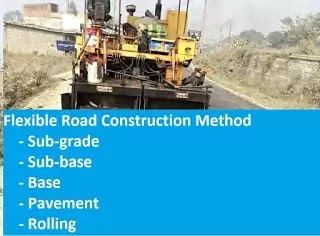 |
| Road Construction Step |
The
methods of constructing roads have changed a lot since the first roads were built around 4,000 BC – made of stone and timber
Modern roads tend to be constructed using asphalt and/or concrete.
Bitumen road construction consists of various steps
such as these steps follows one by one.
such as these steps follows one by one.
1. Preparation of Sub-grade,
2. Preparation of Sub-base course,
3. Preparation of
base course,
base course,
4. Bituminous Coat
a.
Prime
Coat
Prime
Coat
b.
Tack
Coat
Tack
Coat
5. Paving of
Bituminous Mix
Bituminous Mix
6. Rolling
7. Seal Coat
1.
Preparation of Sub-Grade
Preparation of Sub-Grade
Sub-grade
preparation works involve Earthwork is one of the major works involved in road construction. It involves the
removal of top
layer of soil, vegetation. Road area is prepared
for the finished formation level. This is usually done using a manually
and mechanically like tractor shovel, grader etc. Below the
formation level,
the soil is
known as the sub – grade.
preparation works involve Earthwork is one of the major works involved in road construction. It involves the
removal of top
layer of soil, vegetation. Road area is prepared
for the finished formation level. This is usually done using a manually
and mechanically like tractor shovel, grader etc. Below the
formation level,
the soil is
known as the sub – grade.
The
required thickness of the pavement layer
is determined by the strength of sub-grade, so it is must important to
make the strong subgrade as
far as possible.
required thickness of the pavement layer
is determined by the strength of sub-grade, so it is must important to
make the strong subgrade as
far as possible.
The can make strength of the subgrade by
doing these works:
doing these works:
– Compacting subgrade
mechanically to a high dry density.
mechanically to a high dry density.
– Remove
vegetation and poor material.
vegetation and poor material.
– Remove
the bad and loose soil by cuttings and replacing with selected fill.
the bad and loose soil by cuttings and replacing with selected fill.
– Providing
adequate subsoil drainage system.
adequate subsoil drainage system.
– Maintain
camber on sub-sub grade for sub soil drainage.
camber on sub-sub grade for sub soil drainage.
Earthworks are
formed by cut-and-fill, and the type of ‘fill’ material must
be considered, not only in terms of its physical properties, but on
the conditions in which it is to be used, and the methods of
compaction.
formed by cut-and-fill, and the type of ‘fill’ material must
be considered, not only in terms of its physical properties, but on
the conditions in which it is to be used, and the methods of
compaction.
Method of Stabilization of Sub-Grade
Generally before sub-base course if we need to make more
strength of road we prepare sub-grade
course with RBM to stabilize the soil and make the sub-grade strong to bear
adequate load which comes from traffic.
strength of road we prepare sub-grade
course with RBM to stabilize the soil and make the sub-grade strong to bear
adequate load which comes from traffic.
River Bed Material (RBM), debris etc.
are used at road area for soil stabilization generally RBM consist of sand, aggregate,
stone and some stone dust for binder. There is no any fix size of the material
but we conform that material should be free from bolder.
are used at road area for soil stabilization generally RBM consist of sand, aggregate,
stone and some stone dust for binder. There is no any fix size of the material
but we conform that material should be free from bolder.
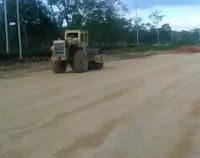 |
| Sub-grade |
2.
Preparation of Sub – Base Course
Preparation of Sub – Base Course
Generally
before base course we prepare sub-base course with the crushed aggregate 63mm
down. We place these materials on road and with the help of grader on such a
way that it provide uniform camber. We should compact the sub base material
with the help of Roller and water browser by draining water on the surface.
Provide roller 0.022 hr/cum with vibration to obtain dry (95-98) % dry density.
before base course we prepare sub-base course with the crushed aggregate 63mm
down. We place these materials on road and with the help of grader on such a
way that it provide uniform camber. We should compact the sub base material
with the help of Roller and water browser by draining water on the surface.
Provide roller 0.022 hr/cum with vibration to obtain dry (95-98) % dry density.
 |
| Sub-base |
3.
Preparation of Base
Course
Preparation of Base
Course
After preparing of layer of sub base course we provide base
material which is 43mm down aggregate. Process are same as sub base course but
material and time of rolling should change i.e 0.033 hr/cum, to make Water Bond
Macadam WBM road. The irregularities are filled in with premix chippings at
least a week before laying surface course. If the existing pavement is
extremely way, a bituminous leveling course of adequate thickness is provided
to lay a bituminous concrete surface course on a binder course instead of
directly laying it on a WBM.
material which is 43mm down aggregate. Process are same as sub base course but
material and time of rolling should change i.e 0.033 hr/cum, to make Water Bond
Macadam WBM road. The irregularities are filled in with premix chippings at
least a week before laying surface course. If the existing pavement is
extremely way, a bituminous leveling course of adequate thickness is provided
to lay a bituminous concrete surface course on a binder course instead of
directly laying it on a WBM.
 |
| Base Course |
4.
Bituminous
Coat
Bituminous
Coat
a.
Prime
coat
Prime
coat
This coast is applied after base course for this reasons :
·
To fill the capillary voids
To fill the capillary voids
·
To coat and bond loose material on the surface
To coat and bond loose material on the surface
·
To harden or toughen the surface.
To harden or toughen the surface.
·
To provide adhesion between bituminous and granular material.
To provide adhesion between bituminous and granular material.
We must provide (6-9) kg per 10sqm prime coat on WBM road.
To make 1-ltr prime coat se need (80/100) bitumen 1.05 kg and
Kerosene 0.10 kg and burn it on adequate temperature.
Kerosene 0.10 kg and burn it on adequate temperature.
It is vital to be aware of weather conditions when apply an asphalt
prime coat. In the case of wet weather, you should postpone this step to avoid
runoff into the water supply.
prime coat. In the case of wet weather, you should postpone this step to avoid
runoff into the water supply.
b.
Tack
coat
Tack
coat
A tack coat is applied after the prime coat, to form an adhesive bond
between the tack coat and the next layer of coating. The tack coat prevents
slippage and may sometimes function as a more long-term sealer to protect the
substrate from moisture and bacteria.
between the tack coat and the next layer of coating. The tack coat prevents
slippage and may sometimes function as a more long-term sealer to protect the
substrate from moisture and bacteria.
A tack coat of bitumen is
applied at 6.0 to 7.5 kg per 10 sqm area, this quantity may be increased to 7.5
to 10 kg for non-bituminous base.
applied at 6.0 to 7.5 kg per 10 sqm area, this quantity may be increased to 7.5
to 10 kg for non-bituminous base.
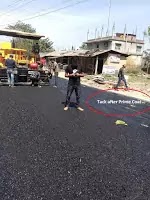 |
| Tack coat |
5.
Paving of Bituminous mix
Paving of Bituminous mix
Bituminous
mix paving with equal thickness and making camber on the road surface. At first
10mm down silicon aggregate and 80/100 bitumen material used for premix or it
is prepared in a hot mixture plant of a
required capacity with the desired quality control. The bitumen may be heated
up to 150 – 177 deg C and the aggregate temperature should not differ by over
14 deg C from the binder temperature. Both are mixed up
mix paving with equal thickness and making camber on the road surface. At first
10mm down silicon aggregate and 80/100 bitumen material used for premix or it
is prepared in a hot mixture plant of a
required capacity with the desired quality control. The bitumen may be heated
up to 150 – 177 deg C and the aggregate temperature should not differ by over
14 deg C from the binder temperature. Both are mixed up
The
hot mixed material is collected from the bitumen mixture by the transporters,
carried to the location is spread by a manually of mechanical paver at a temperature
of 121 to 163 deg. Celsius the camber and the thickness of the layer are
accurately verified.
hot mixed material is collected from the bitumen mixture by the transporters,
carried to the location is spread by a manually of mechanical paver at a temperature
of 121 to 163 deg. Celsius the camber and the thickness of the layer are
accurately verified.
The
control of the temperatures during the mixing and the compaction are of great
significance in the strength of the resulting pavement structure. The temperature
of mixed material during laying is not less than 105 degree Celsius.
control of the temperatures during the mixing and the compaction are of great
significance in the strength of the resulting pavement structure. The temperature
of mixed material during laying is not less than 105 degree Celsius.
 |
| Carpeting |
6.
Rolling
Rolling
When after placing bitumen mixture on
the base course is than it is equally and thoroughly compacted by static
rolling at a speed not more than 5km per hour or use vibration. In rolling a
graded area with a side slope, as a crowned or banked road, you should work
from the edge to the center of the of the road which is known as camber
the base course is than it is equally and thoroughly compacted by static
rolling at a speed not more than 5km per hour or use vibration. In rolling a
graded area with a side slope, as a crowned or banked road, you should work
from the edge to the center of the of the road which is known as camber
The static rolling is done by (8 – 12)
tonnes roller and the intermediate rolling is done with a fixed wheel pneumatic
roller of (15 – 30) tonnes having a tyre pressure of 7kg per sq.cm. The wheels
of the roller are kept damp with water. The number of passes required depends
on the thickness of the layer. The final rolling or finishing is done by 8 to
10 tonne tandem roller.
tonnes roller and the intermediate rolling is done with a fixed wheel pneumatic
roller of (15 – 30) tonnes having a tyre pressure of 7kg per sq.cm. The wheels
of the roller are kept damp with water. The number of passes required depends
on the thickness of the layer. The final rolling or finishing is done by 8 to
10 tonne tandem roller.
 |
| Rolling |
7.
Seal coat
Seal coat
Final
coat of bituminous material applied during construction to a bituminous macadam
or concrete for sealing the surface of the pavement. In this coat sand mix up
with bitumen and spread on road to plug the void and final rolling is done with
8-10 tonne roller.
coat of bituminous material applied during construction to a bituminous macadam
or concrete for sealing the surface of the pavement. In this coat sand mix up
with bitumen and spread on road to plug the void and final rolling is done with
8-10 tonne roller.
Some Test is important during Road Construction
1. Sub
grade test for thickness of pavement
grade test for thickness of pavement
2. Aggregate
gradation Test
gradation Test
3. Grade of
Bitumen Test
Bitumen Test
4. Field
Density Test after Rolling
Density Test after Rolling
Most important thing temperature of
mixture check during unloading or paving it should not less than 105 degree
Celsius & for every 100 sq.m of the compacted surface, one test of the
field density is conducted to check whether it is at least (95-98) % of the
density obtained in the laboratory. The variation in the thickness allowed is
6mm per 4.5m length of construction.
mixture check during unloading or paving it should not less than 105 degree
Celsius & for every 100 sq.m of the compacted surface, one test of the
field density is conducted to check whether it is at least (95-98) % of the
density obtained in the laboratory. The variation in the thickness allowed is
6mm per 4.5m length of construction.