
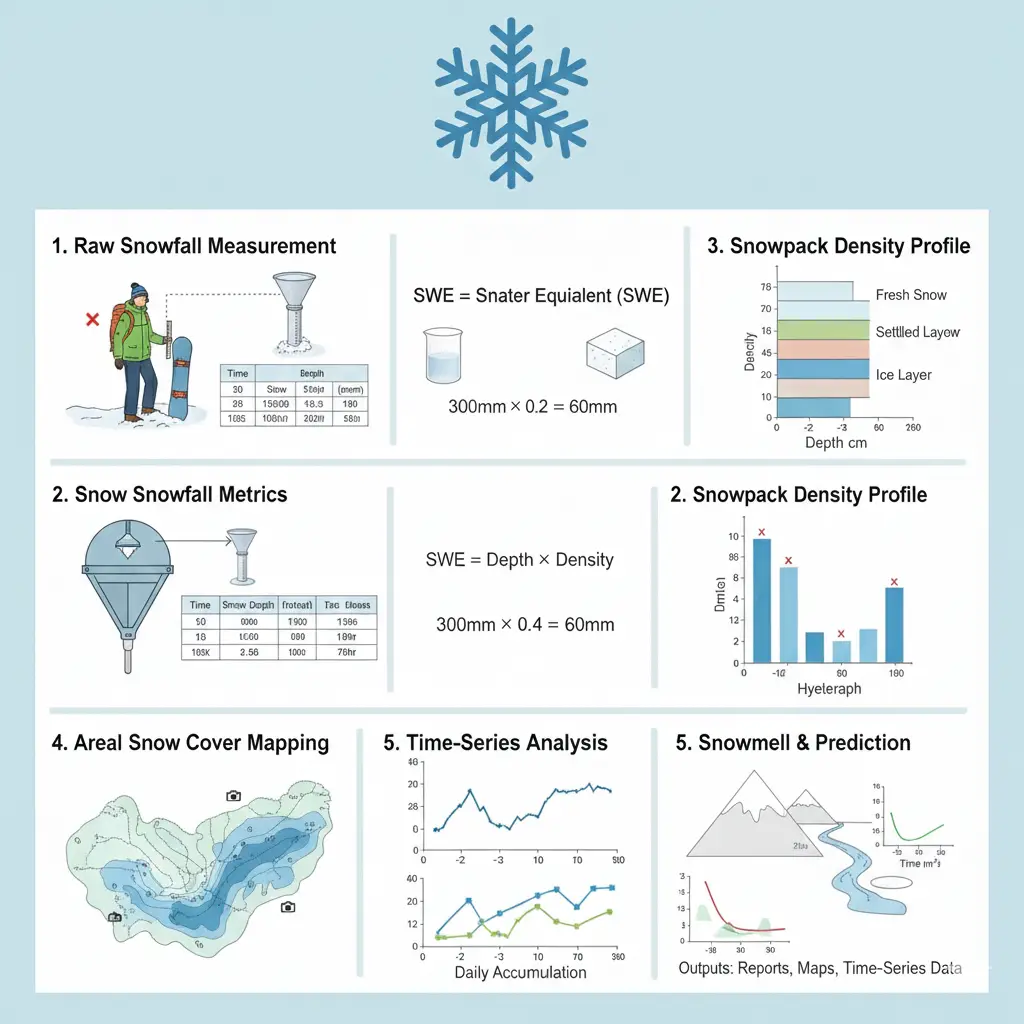
Snowfall Analysis for Kitchener City
Hydrology Engineering Design – Snow Water Equivalent Calculation
Project Overview
This tool calculates Snow Water Equivalent (SWE) for Kitchener City using data from 6 snowfall measurement stations. The analysis follows standard hydrology engineering practices and US design codes.
Snow Water Equivalent represents the amount of water contained in a snowpack, which is critical for water resource management, flood forecasting, and climate studies.
Input Parameters
Typical values: 0.01-0.15 (new snow), 0.1-0.2 (damp snow), 0.2-0.3 (settled snow)
Standard value for pure water at 4°C
Calculation Methodology
Step 1: Calculate Snow Water Equivalent (SWE) for each station using the formula:
SWE = Snow Depth × Snow Density
Step 2: Calculate the weighted average SWE for the entire area using Thiessen Polygon Method:
Weighted SWE = Σ(Station SWE × Station Weight)
Station Weight = Station Area / Total Area
Step 3: Calculate total water volume from snowfall:
Water Volume = Weighted SWE × Total Area
Note: All calculations follow US standard engineering practices for hydrology.
Design Assumptions: Snow density is assumed constant across the study area. The Thiessen Polygon Method is used for spatial averaging, which assumes rainfall at any point within a polygon is the same as that of the nearest gauge.
Reference: Kitchener City area is approximately 136.86 km². Station locations and areas are representative of actual measurement networks.