
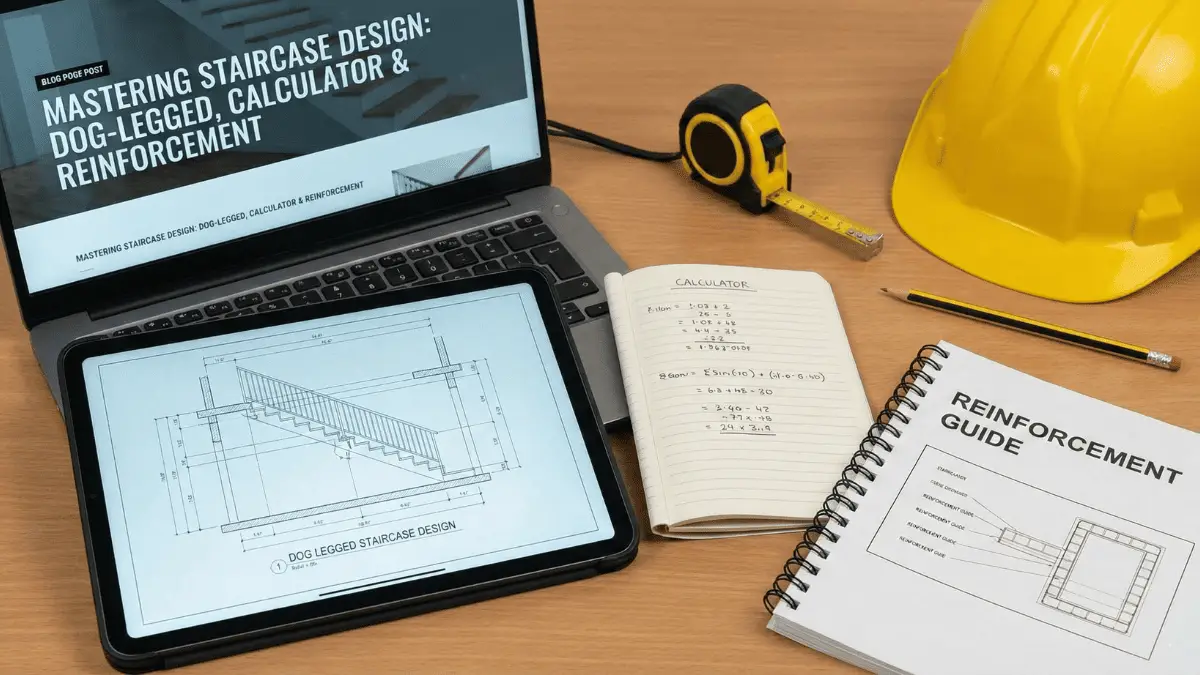
Dog Legged Staircase helps us to calculate the value and also helps us to get the complete design and staircase drawing.
Dog-Legged Staircase Design (IS 456:2000)
Designing a dog-legged staircase is one of the most common challenges faced by civil engineers and architects in residential and commercial construction. This type of staircase, characterized by two parallel flights with a 180-degree turn at a mid-landing, is not only space-efficient but also structurally sound when designed correctly. To simplify this complex process, I've developed an interactive Dog Legged Staircase Calculator that follows IS 456:2000 standards, ensuring your design meets all structural safety requirements.
What is a dog-legged staircase?
A dog-legged staircase, also known as a switchback staircase, consists of two flights of stairs running in opposite directions with a landing in between. When viewed from above, the flights appear to fold back on themselves like a dog's hind leg—hence the name. This design is extremely popular in Indian construction due to its efficient use of space and straightforward structural behavior.
The key advantage of this configuration is that it fits within a relatively compact stairwell while providing adequate headroom and comfortable ascent. The mid-landing also serves as a resting point and improves safety by breaking up what would otherwise be a long, continuous climb.
Understanding the Design Process
Designing a dog-legged staircase involves several critical steps, each requiring careful calculation and adherence to building codes. Let me walk you through the comprehensive design methodology that my calculator automates.
1. Geometric Configuration
The first step in staircase design is determining the proper geometry. According to IS 456:2000 and NBC (National Building Code), the relationship between riser (R) and tread (T) should satisfy the formula: 2R + T = 550-700mm. This ensures comfortable climbing.
For a typical residential building with a floor height of 3 meters and a riser of 150mm, you would need 20 steps total—10 steps per flight. The calculator automatically distributes these steps equally between the two flights, ensuring balanced loading and comfortable use.
2. Load Calculations
Accurate load calculation is crucial for structural integrity. The total load on a staircase comprises:
- Self-weight: This includes the weight of the concrete slab along the inclined path. The calculator accounts for the actual path length using trigonometry (considering the angle of inclination) rather than just the horizontal projection.
- Live Load: As per IS 456:2000, residential staircases should be designed for a minimum live load of 3 kN/m². For public buildings, this increases to 5 kN/m².
- Floor Finish Load: This accounts for tiles, plaster, and other finishes, typically around 1 kN/m².
The calculator applies a load factor of 1.5 to arrive at the factored load, as required by limit state design methodology.
3. Structural Analysis
The staircase slab acts as a one-way slab spanning between supports. For dog-legged stairs, each flight is analyzed as a simply supported slab spanning from floor to landing (or landing to floor). The design moment is calculated using the standard formula:
Mu = (w × L²) / 8
Where:
- w = factored load per unit width
- L = effective span (length of the flight)
- Mu = ultimate bending moment
4. Depth Determination
The required effective depth of the slab is calculated to resist the bending moment. The calculator uses the formula derived from IS 456:2000 for singly reinforced sections:
d = √(Mu × 10⁶ / (0.138 × fck × b))
Where:
- d = effective depth required
- fck = characteristic compressive strength of concrete (typically 25 MPa)
- b = width of the section (1000mm for per meter width calculation)
The calculator then checks if the provided depth (based on the staircase geometry) is adequate. If not, it alerts you with a clear warning.
5. Reinforcement Design
Steel reinforcement is essential to resist tensile stresses in the slab. The calculator determines the area of steel required using:
Ast = Mu × 10⁶ / (0.87 × fy × d)
Where:
- Ast = area of steel required per meter width
- fy = yield strength of steel (415 MPa for Fe 415)
- d = effective depth
The calculator then suggests a practical bar spacing. For instance, if you're using 12mm diameter bars, it calculates how many bars per meter you need and converts this to a center-to-center spacing, making it easy for field implementation.
6. Deflection Control
Excessive deflection can lead to cracking and serviceability issues. IS 456:2000 specifies maximum span-to-effective-depth ratios to control deflection. For simply supported slabs, this ratio should not exceed 20.
The calculator automatically checks this ratio and warns you if deflection control requirements aren't met, suggesting you increase the slab depth if necessary.
Material Quantity Estimation
One of the most practical features of this calculator is its ability to estimate material quantities. Construction planning requires accurate estimation of:
- Cement: Calculated based on 8.5 bags per cubic meter of concrete
- Sand: Approximately 0.45 cubic meters per cubic meter of concrete
- Coarse Aggregates: Approximately 0.9 cubic meters per cubic meter of concrete
These estimates help in budgeting and procurement planning, ensuring you order the right quantities for your project.
Key Features of the Calculator
User-Friendly Interface
The calculator features an intuitive interface where you input basic parameters:
- Height of floor (meters)
- Length of stairwell (meters)
- Width of stair (meters)
- Riser height (millimeters)
- Tread width (millimeters)
- Live load (kN/m²)
- Floor finish load (kN/m²)
Comprehensive Output
Upon calculation, the tool provides:
- Design Summary: Quick overview of all critical design parameters
- Detailed Calculations: Step-by-step breakdown of every calculation, allowing engineers to verify the methodology
- Visual Representation: A scaled drawing showing the profile view of the staircase with proper dimensions
- Status Indicators: Color-coded checks (green for adequate, orange for warnings, red for failures) make it easy to spot issues
IS 456:2000 Compliance
All calculations strictly follow IS 456:2000 guidelines, ensuring your design meets Indian standards for structural safety. This is crucial for obtaining approvals from local authorities and ensuring the longevity of your structure.
Practical Application Tips
When using the calculator for real projects, keep these points in mind:
- Verify Inputs: Double-check your floor height measurements. Even small errors in input can lead to uncomfortable stair geometry.
- Consider Headroom: Ensure adequate headroom (minimum 2.1 meters) beneath the upper flight. The calculator doesn't check this automatically, so verify separately.
- Check Local Codes: While the calculator follows IS 456:2000, your local building authority may have additional requirements.
- Distribution Reinforcement: Don't forget to provide distribution steel perpendicular to the main reinforcement (typically 0.12% of cross-sectional area).
- Detailing: Proper detailing at supports, especially at the landing, is crucial for structural integrity.
Conclusion
The Dog Legged Staircase Calculator simplifies what is traditionally a time-consuming design process. By automating complex calculations while maintaining full transparency through detailed step-by-step solutions, it serves as both a design tool and an educational resource.
Whether you're a practicing civil engineer, an architecture student, or a contractor looking to verify designs, this calculator provides reliable, code-compliant results in seconds. The visual representation helps in better understanding the structure, while the material quantity estimates aid in practical construction planning.
Remember, while this calculator provides accurate preliminary designs, complex projects should always be reviewed by a qualified structural engineer who can account for site-specific conditions and local building regulations. Use this tool as a starting point to streamline your design process and ensure your dog-legged staircases are safe, functional, and economical.